My llama named Addie
Origin
All heroes wear capes, I’ve never heard the opposite of that. However, had you been one of the multitudes of people looking for a rental copy of Titanic on September 1, 1998, you would’ve sworn all villains wore Blockbuster polos.
I was a junior in high school and learning quickly the level of wrath someone could aim at a minimum-wage-earning teenager for uttering the phrase “Sorry, we’re out of that one.”
Despite having two shelves’ worth of VHS copies of Titanic, a copy wouldn’t survive thirty seconds once reshelved. I’d been instructed, almost a year prior, with hours of video instruction from the ’80s, on how to ensure a customer had the best experience while visiting the Blockbuster I’d be working.
The horde didn’t care and found no pity for me or my co-workers. They were relentless, and no amount of that training had prepared me for them.
I’d been trying to decide what kind of sample project to build after the simpler Content Picker on this site’s home page. I wanted something that took advantage of the branching opportunities available in Storyline. Once those dark days of my high school employment came to mind, the choice was obvious: an angry customer de-escalation training module.
The Content Picker had been something of a glorified personality test. Aside from reworking the language on a few questions and adding an explainer screen before the results, there wasn’t much methodology behind it. This time I wanted to present something that didn’t just look like a finished module, but demonstrated an actual understanding of how people learn. I needed a method to my madness.
An instructional design friend had introduced me to ADDIE and its foundational role in the discipline. It felt like familiar territory, close to the creative process I’d already used as a video producer: understand the subject, design the stylistic approach, develop the scripts and materials with the creative team, release the finished piece, then review the KPIs and feedback.
As I learned more about ADDIE I began to have flashbacks to challenges I had with corporate video production. Pre-production was a list of a thousand questions that for one reason or another “needed” to be answered now, rather than when the creative team had the full picture. The challenges only compounded when each partially informed decision created a cascade of other issues. We, much like designers using ADDIE, planned for what we knew at the time.
It was like wanting a sandwich in the 1800s and needing to grow wheat before you could even consider such a thing. And, hopefully, months later when you had the bread you still wanted a sandwich.
I read more about other approaches to ID and learned of the 2012 revolution declared by Michael Allen with his introduction of SAM, Successive Approximation Model. Leave the wheat field and step into the freezer aisle. SAM could build something rough by the end of the afternoon. Put it in front of somebody. Fix what’s wrong. Do it again. The same solution as a Hot Pocket. Fast, hot, in your hand in ninety seconds.
But, much like a Hot Pocket, a course designed with SAM looked like it could become quickly disconnected from the original need. I’d seen firsthand small video projects grow into massive undertakings because more people kept coming to the table with ideas. Hot Pockets and everything else in the frozen food aisle are made with toppings someone else chose in the hopes someone will want it. It’s fast, but does it do more than resemble the idea that brought it to life? Or is it more the child of whomever spoke last?
SAM was rooted in Agile methodology from the coding and developer world. A method that starts with a minimum viable product and then moves in cycles back through the development process to add incremental improvements to the product. I loved the ideas behind Agile and tried to bring some of the thinking into how I approached producing videos. Getting to the core of the purpose and then building from there, keeping that core purpose as a cornerstone that the entire production rested upon.
Curious about the way others were using Agile in instructional design led me to Megan Torrance. And it felt like discovering the inventor of sliced bread. Listening to an episode of The eLearning Coach, Connie Malamed’s podcast, where she and Megan were applying Agile principles to eLearning projects. An idea she and her team had given the tongue-in-cheek name of LLAMA: Lot Like Agile Management Approach.
Here was a method that didn’t respond to a wheat field with a frozen food aisle. I found myself in the bakery. Bagged sliced bread could go home with me and be a sandwich quicker than ninety seconds and not have that weird frozen spot in the middle. I could also select a loaf of freshly baked bread for an upscale french toast weekend brunch menu.
This was flexibility that considered my appetite and not a past desire for a sandwich.
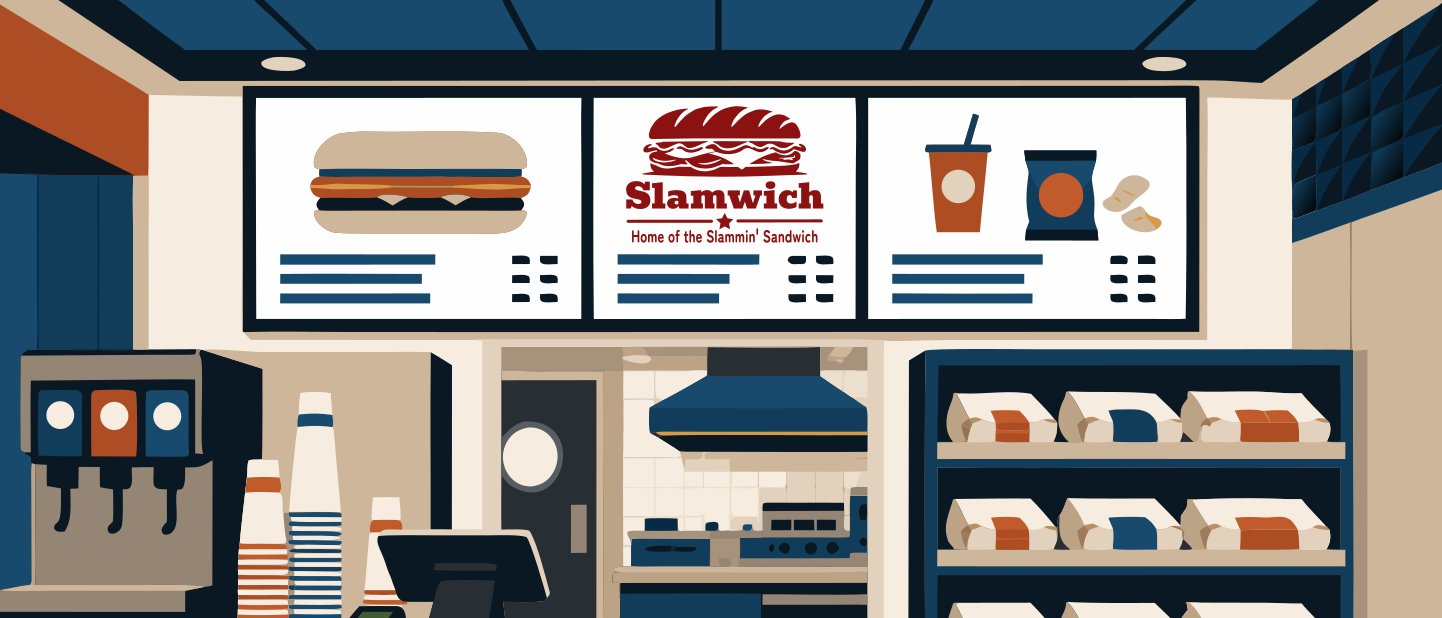
My llama, named Addie, would be my guide while developing a module for a mock fast-food sandwich chain named Slamwich, Home of the Slammin’ Sandwich, revolving around de-escalating with angry customers.
“The horde didn’t care…they were relentless, and no amount of that training had prepared me for them.”
Exploration
Storyline has been one of the easier programs to pick up, due mainly to the breadth of tutorials and learning materials offered for free on Articulate’s website. It was during one of the eLearning Heroes video tutorials that I first had the inkling of the idea that would become Slamwich.
The video was an introduction to variables. One example was capturing the learner’s name, and the instructor suggested some ways to use it.
“On a name tag.”
This was all I needed to hear to set the creation of Slamwich into motion. I could use additional variables to drive the branching and feedback mechanisms I wanted to include in the finished project.
The fit was perfect.
I sketched out the basic flow of the module. A learner would select a character to represent them and enter their name, which would appear on the character’s name tag throughout the module. I had never worked in food service, I knew I didn’t have the temperament for it. So I thought back to my Blockbuster days for the complaints. Our not having a movie, or a customer discovering the wrong movie in the case when they got home, were the two that seemed to map onto a fast-food complaint: wrong order, or an unavailable menu item.
The last major Blockbuster complaint was that a customer’s child and their friend had run up whatever fine was preventing them from renting their current selection. That didn’t seem to fit the problems Slamwich crew members might face.
Thankfully, my partner had spent time managing a small fast-food establishment in college. A few years younger than me, his more recent experience meant he could tell me how onboarding had changed in the twenty years since I’d stood behind a Formica counter.
I explained the basic concept of the module and asked for a third suggestion to round out the sample. Two was, for whatever reason, never enough.
He wasn’t the backroom manager I remembered from my days in retail. He was working alongside the staff, and he was the one who had to onboard new hires himself, which meant no bandwidth to stand over a new employee’s shoulder while they worked through training materials. A day-in-the-life narrative felt like the right approach for that reason alone. If the learner needed to self-sustain, putting them into their future self’s shoes would connect better than having them sponge information from videos of awkward corporate actors.
The second insight was a final suggestion for a customer complaint: an unclean bathroom. The two prior complaints, wrong order and unavailable item, already had something of an escalation to them. A third that felt like an even bigger one, the kind that could cost future business, the cardinal sin of corporate training, made a good “third act” for the customer interaction segment.
The wireframe of the project was complete, the variables mapped out, and the artwork needs were defined. I could move into the much more enjoyable development and design stages.
“No bandwidth to stand over a new employee’s shoulder while they worked through training materials.”
Loop
Starting a Storyline project is kind of like the first day on a set for me. A giant empty room, gear piled in the corner in multicolored hard cases. Sure, it looked like nothing at the beginning of day one. But you got to be there while it transformed. Grew. Evolved from nothing into something.
Placing the crew-member art files and customers with their different emotional reactions was like blocking actors. Filling in the speech bubbles telling the story of each vignette was like running lines with the talent. Placing buttons and adding backgrounds to make the text pop more was like setting up lighting and scenic for the scene.
When I say development and design is the more fun part, I don’t just mean I get to leave behind the Excel spreadsheets of variable names and Word docs of scripts. Now I get to play a little and make something at the same time.
Copy and paste might be my favorite feature of the modern computer, but it can prove dangerous when used without thinking.
I had laid out the first loop of customer interaction. The crew member would greet a customer, the next slide would be the customer complaint, a following slide would present three replies to the learner, and then, based on the answer, the following slide would show a different customer reaction.
One copy and paste later, I had the second loop. I swapped all of the artwork out and moved on to the next, moving into the outline view and scrolling out to see the full project and place the next set of slides. This was the first time I’d seen the full project actually diagrammed. I hadn’t written out every slide in the wireframe, it was a hand-drawn sketch to help me keep track of things.
What I was looking at was a maze of overlapping lines diagramming the connections between slides, showing how a learner could potentially move through the module. It was a mess Spider-Man would’ve been proud of. And I didn’t dare hit control-v anymore. I needed a new approach, because despite having just done this work myself, I didn’t know what I was looking at.
If I needed to make changes, it had the potential to break the whole web. Leaving Peter Parker and me sore and out of luck.
I went back to eLearning Heroes and watched a few more tutorials. Not knowing what I didn’t know, it was hard to Google a direct question to diagnose the issues I’d created for myself. One of these tutorials held my solution: updating the states of an object based on the variables I was collecting, rather than redirecting to an entirely new slide.
The spider web became something I could easily trace from one point to another. I could see the learner’s path and clearly understand where they were coming from and going to, based on the hard numbers I was automatically collecting from button pushes.
Building out the third customer interaction now was driven by the question: was this going to be something that updated in the same footprint, or something that needed a whole new slide? Was I moving from a medium shot to a close-up, or were we moving from interiors to a car chase?
It was a familiar question, the same one that shaped how I’d structure a shoot to run efficiently. Do I build this from scratch, or is there something already here I can reuse?
“Copy and paste might be my favorite feature of the modern computer, but it can prove dangerous when used without thinking.”
Loop, again
While testing the various mechanics of the module, I found myself in a bit of a rabbit hole testing names for the name tag. I knew this wasn’t a real module going out into the wild where people would put any manner of name into the name tag blank. I knew that most people who toured this mock module wouldn’t run into their name spilling into a second row or extending past the bounds of the name tag itself. But I needed to be sure.
I asked Google and Claude about the longest names in the English language and was often reminded this wasn’t a fixed set like a dictionary. A name could be spelled with as many or as few letters as the birth parents deemed necessary. Searching for test names led me to a person named Mahershalalhashbaz Gorton, the daughter of Samuel Gorton, an early New England colonist and the founder of Warwick, Rhode Island.
Eighteen letters in her first name. Though I went to school with a kid whose parents spelled it with eight, so there’s no accounting for what you’ll come across.
It was in one of these name tag testing loops that I first had a sense of something being off. I would start up the module and be met with the character choice and name tag screen, which just began to feel wrong, or late, or something. It was missing context that a learner would need to not only get the point of the module but also be able to answer the questions correctly.
I’d done this hundreds of times in messaging and fundraising videos. I wouldn’t plop the audience down in the middle of an interview without giving them the framework for understanding the video. Maybe that’s a twenty-second graphic in the open that recaps the organization’s history, or an interview with the leadership. Something that helps the audience get their feet under them. In this case, my solution was inspired by a few corporate clients I’d worked with in the past, and the mission statements that anchored every project we produced together.
I wrote the Slamwich Promise statement that would be the foundational idea a learner could think back to during the training to help guide them to the best choice of replies. Landing on the new slide between the title screen and setting up the learner’s character already made the module feel more official.
As mechanics testing continued and various bugs were squashed, I noticed a second issue. Thinking back to my scope, I remembered the learner would be sitting more or less alone with the training module. The manager would be working, available to ask questions, but not for the motivational guidance an in-person instructor would provide, leading the learner through the information and translating the corporate speak of the Slamwich Promise into something a real person would say while training a new hire.
I had downloaded an excess of art files for characters and had already repurposed one extra head art to make a female crew member. So I took a second extra head and made my manager character. His name, Ben S, is a little Easter egg in reference to literature’s worst manager, Ebenezer Scrooge, though I took my character in a decidedly different direction.
Ben was added to personalize the whole module. Add someone who is there, in the learner’s corner, letting them know what to expect and how they did, with conversational copy. The head art also offers the ability to customize the manager’s reaction to how a learner did overall on the module. All greens and you get a toothy smile and a great job; one or two misses and he’s showing fewer teeth and mentioning the need to train further; get everything wrong and the manager looks disappointed and mentions a full review before heading back out onto the floor. The learner is also offered up to three attempts to get that wide smile and glowing review.
I was able to run through the module in full, my new manager giving some words of wisdom before the shift segment I’d be working, and some words of encouragement afterward, before the learner would review their results. Because nobody dives right into reviewing someone’s performance without a little small talk first.
This loop-back-and-review habit caught two problems that a wireframe or an outline view would never have surfaced, not failures in how the module functioned, but in how it felt to a learner experiencing it for the first time. That’s where the wheat field fails: full Development finished and signed off before anyone has set a sandwich on a plate. Both gaps would have baked straight through to Implement, discovered only once real learners finally got their first taste.
“That’s where the wheat field fails: full Development finished and signed off before anyone has set a sandwich on a plate.”
Landing
Moving through the module once, I would make everyone happy. Then, over a few more training sessions, I would aggravate each customer one at a time. My manager’s emotions flicker from one to another like an exhausted toddler.
With a careful tally, I ensured I had moved through every potential path. I needed to move on to another, and as much as I enjoyed testing, I needed to continue on my portfolio building. I was using the trial version of Storyline and had a strict timeline for the development of each portfolio project. I was walking through the bakery, not the wheat field, because I didn’t have the luxury of time.
But speed wasn’t the only benefit I’d found. Being able to quickly taste ideas helped me shape the sandwich for the better, discovering improvements by quickly implementing ideas and frequently asking the learner how the menu was looking. What had started as a simple cheese sandwich had evolved from grilled cheese into the Monte Cristo.
Had I been able to get this in front of actual learners, I might’ve made a croque monsieur, though I’ve never known the difference between the fancier types of grilled cheeses.
But I was able to evolve what I’d initially set out to make because Addie, my llama, was always ready with the familiar roadmap to take me back to the bakery. Looping back through the development and design phases after putting together the first iteration of the module helped me see the missing context ADDIE would’ve discovered from learner feedback after rollout. Looping back further, to include the assessment phase during the second round of testing, uncovered an issue of the information feeling sterile, which led to the invention of a manager character that would’ve come, maybe, in next year’s version of the training had I stayed fully committed to an ADDIE approach to this module’s development.