The Destination Before the Shot
The opportunity
I think the only other people, aside from event professionals, who truly understand the chaos of a load-in are parents who have helped move a child into a dorm.
The single-minded focus of every person within the limited space is to finish their own task, quickly.
A group of stagehands unboxing equipment is shouting at one another over the squeal of the cherry picker hanging signage and truss overhead. A golf cart carrying important-looking convention staff nearly misses a forklift carrying a twelve-foot-long open crate of upright drape poles. An army of knee-padded, blue-tape-wielding carpet layers crawls around affixing different types of carpet to the hard convention hall concrete floor. Short blasts of pink or white noise come from audio-visual systems being fired up and tested after a long ride from distant warehouses.
The air is also stale and heavy. The paying customers, the coveted attendees, aren’t in the house yet so no more than the needed air conditioning is provided. The show week will be brisk, but load-in weekend is hot and sweaty. The only havens: a sometimes offensive offering of overpriced vending machines. Or the hot water that had been sent along with the gear on the back of the truck.
The stagehand is also the only person keeping the portable radio companies in business. In a time when every person on earth has an inexpensive pair of wireless headphones, the stagehand will walk onto a jobsite with a sticker-encased radio and twist the dial to actual people talking between songs. Songs played by bands you’d heard of, but never the hits you remembered.
“I worked this show in ’82.”
“I was backstage for the ’91 tour and the manager was a jerk…”
These people had been in the business of events since the term came to Columbus. They had set up and torn down every big event the city had hosted. All to the tune of Aerosmith and Ted Nugent B-sides.
It was this I walked into. Returned to. I hadn’t been in the convention center since March of 2020 for the last Arnold Sports Festival.
I was meeting a new client of mine, one of the first for Chapman Creative, and someone who was new to event video production. The ACerS marketing manager and I had been introduced by a mutual friend I’d made back in the days of working on the ASF promotional videos. We’d traded a few emails to discuss the event and the content needs. This was our first in-person meeting.
“Lost cities were more easily found than an open outlet
in a convention center.”
The approach
By the time I arrived, most of the chaos was a dull murmur and my client and I could walk the space as final touches were added.
Event staff walked their finished booths for the first time, arranging trinkets and marketing brochures. The click of drape backdrops being raised into place could be heard in a far corner as a divider between show and backstage was established. Another golf cart toured the space with excited-looking event producers.
My client was in the newer glass atrium of the convention center that looked out onto High Street. The American Ceramic Society had their event booth set up amid other sponsors along the outer wall. I’d taken advantage of LinkedIn and found a picture of the man I was meeting—thankfully he hadn’t altered his appearance with facial hair or a radical new hair style—and I was able to easily find him and introduce myself.
Their table was a mix of materials touting the benefits of membership and stress balls that looked like Albert Einstein.
“These are the greatest pieces of swag I’ve ever seen,” I joked. Having worked more conferences than I can remember, I couldn’t think of an alternative.
“Thanks, we just got a new vendor so all the older members are trying to rush the table to have a ‘new’ and ‘original’ Einstein,” the client explained. “Do you want one?”
I would learn over the next few days these were among the world’s most generous people when it came to sharing their swag, the shorthand for the kitschy items every booth has with their company logo and contact information laser printed on them. One booth, a company that was designing 3D printers to send to Mars to help future colonization missions build needed supplies rather than ship them from Earth, built me a custom grab bag that contained several suckers, an astronaut-shaped stress ball and a packet of Pop Rocks they’d rebranded Space Rocks. I learned, early on, a simple comment on how cool I found something was followed up by a quick offer to have one.
I’d filmed a few interviews in the space before. The Arnold has pre-race check-in and was always a great place to find photogenic people happy to talk about how amazing it was waking up at 5 a.m. to run the streets of downtown Columbus. The mix of glass and tile floor was nice to look at on film but provided something of an echo chamber for audio recording. There is a basic Catch-22 at work in every event video production—the interview subjects are only available between the event sessions they’re attending or leading. That’s also when every other attendee is in the concourse traveling to their next breakout room or to the event hall to see the trade show. A crowded space is also a better backdrop, because empty hallways send an undesired message.
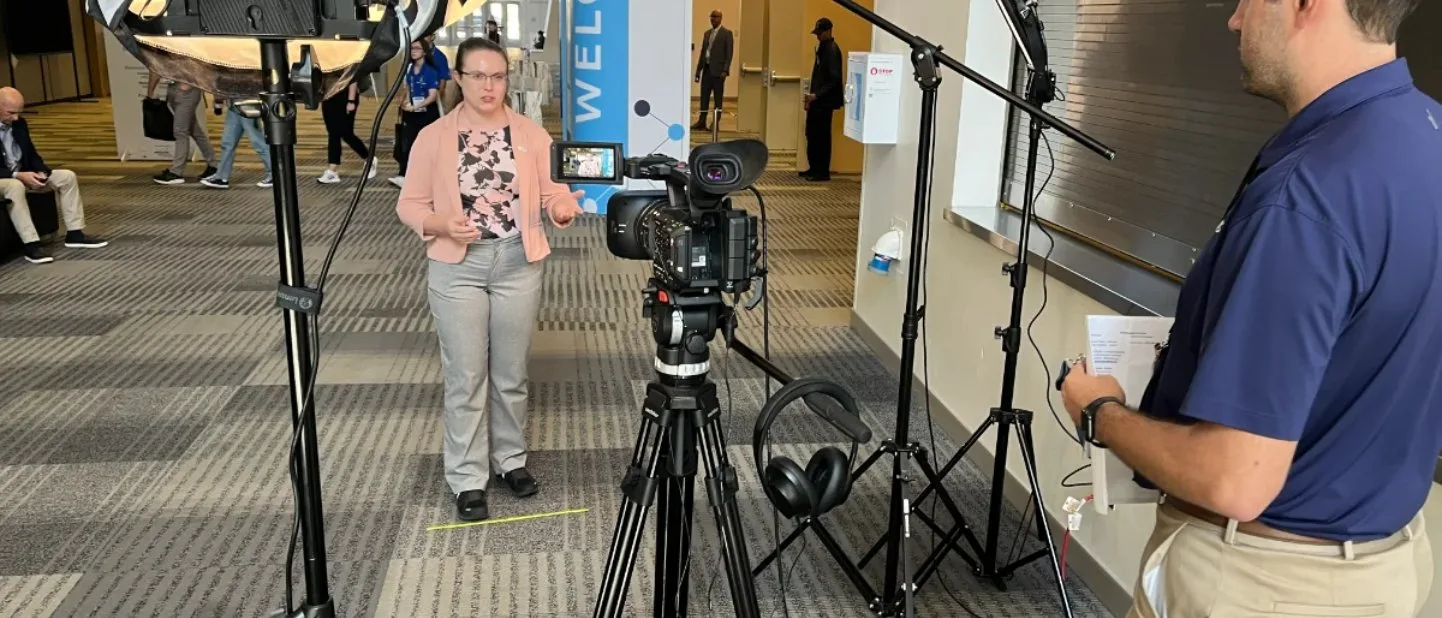
An intrepid audio engineer I worked with discovered something of a sweet spot for recording in the space and I walked the client over to explain the benefits. Standing him where I would place the camera and taking the place of the interviewee would allow him to picture the final image I was describing. Where we stood the atrium was narrowing into a hallway that led attendees to smaller breakout rooms. The carpeting would not only be much nicer to stand on for the interviewee, but would also soak up a good portion of the echoes bouncing around the cavernous space. An outlet around the corner would also eliminate a personal pet peeve of mine, running power across walkways. It’s my opinion any good shot is ruined when it makes the space less safe by adding a trip hazard.
“We can film here for these first couple and then move to another location,” I explained. The gear I’d selected was light and portable—built with the idea of a ready-made setup a subject could walk into, not something that needed to be built around each subject. Shotgun microphones over lavaliers, broad lighting panels shaped with diffusion and lightweight cameras with a generous 24–70mm zoom that covered everything from wide shots to interviews.
I stopped us next to a shuttered event office. A charitable name for a ten-foot-by-ten-foot empty box of a room with a roll-up, concession-style window that could be used for ticketing, will call or coat check. Oftentimes it was where event producers hid between client requests, drank tepid coffee and answered the unending emails from clients future, past and present.
I don’t know if it was code or what, but in a convention hall, you could always find an outlet under the ledge of the concession window. It made for a popular location to charge devices in what was otherwise a desert of electricity. Lost cities were more easily found than an open outlet in a convention center.
This location would also provide a favorite backdrop for our next batch of interviews—the trade show main entrance. It would see a steady stream of people throughout the day and would help me avoid one of my most hated event production happenings. People occupied with getting their badges scanned for entry wouldn’t stare into a camera in the background.
“The worst is when they walk into each other.”
“I bet.”
“I’ve always got to be pre-editing in my head. If we get a great answer and that happens, I can make sure we get it again.”
We walked through the trade show floor, almost shut down for the evening, and I pointed out a few places I would stash a GoPro timelapse camera throughout the event day. With the advent of battery packs to charge smart devices on the go, action cameras have become something event videographers simply cannot leave behind. 4K timelapse footage not only looks great as standalone social content or in a demo reel, it’s a great piece of transitional footage to keep on hand.
We returned to the ACerS table, now more crowded with the rest of the team done with their pre-event tasks and assembling to find out what needed to be done before the day could be called.
I was introduced to the team member who worked directly with the sponsors. She had a list of their highest-level sponsors and we discussed the possibility of offering them the opportunity to film a quick interview after the main interviews were shot. I knew, from experience, the likelihood of success—most of these booths would be staffed with hired help informed enough to answer brand and product questions, not speak on behalf of the company—but she knew them better, and I explained I’d bring along a handheld microphone we could plug into the camera and do man-on-the-street style interview sessions. We would conduct the interviews against a distinct background to give them their own place if they needed the content for alternative social or marketing needs.
My mention of social media brought a worried look to my main client’s face. He searched for the right way to approach the question and slowly explained the different delivery channels they were planning for the content. He was doing mental math, and the numbers were overwhelming. I could see the next question forming. How would he—and, more importantly, I, the person he’d just met—keep all this straight during the filming?
I pulled out my notebook and sketched out what was supposed to be an interview subject but looked more like a keyhole. I drew a sloppy rectangle around my keyhole person and presented my Headroom 101 lesson. Drawing in a second vertical rectangle that indicated the layout of an Instagram video, I walked through how by adding a little extra headroom into the interviews I could export different-sized deliverables. A longer video for their website or an email campaign could be shortened into the highlights for Instagram or YouTube Shorts. Everything exported using custom-sized Premiere projects that matched the channels’ requirements. I was filming in 4K, and this extra size, as well as the filming choices, would give us the flexible footage that fills the needs without needing to list out everything ahead of time.
I taught a handful of classes during company open houses, and this was something I found fun. Answering questions with quick little lessons that hopefully left the person feeling like they got an answer they understood.
Back in my home office I scribbled down a rough schedule for the shoot day. My load-in and when I’d be ready for the first interview to kick off, times I’d move and when I could get onto the trade show floor to move the GoPro camera. Giving it enough time to film at each location for usable amounts of footage.
Good timelapse snaps a shot every five seconds, so it takes about an hour and fifteen minutes to get thirty seconds of footage. It was also like fishing—you had to hope something came through when the net was out. This event had charging stations throughout the event hall, natural magnets for attendees and a good blind for the camera. I would take advantage of both to stack the deck in favor of capturing a good amount of people on camera.
My last bit of preparation is to picture the day in my head and everything I might forget—I’ll put hands on the forgotten piece in my daydream and then continue. Once I’m mentally back home, I open my eyes and move through a checklist of all the items I just finished confirming existed.
Content with what I’d come up with and the day’s meeting, I pulled myself away from the cycle of overplanning and hoped smarter men miscalculated the outcome of best-laid plans.
“If anyone tells you they made zero changes from start to finish, they’re lying or about to hand you a pile of garbage.”
The result
I arrived at the convention center as the first round of classes and breakout sessions were commencing. The concourse and atrium were a ghost town of attendees, save the occasional straggler making a cup of coffee or selecting a pastry from the refreshment stations strategically dotted along the hallway.
Event staff moved between doorways of the classrooms exchanging quick thumbs-up or smiles with the presenters. Sponsor marketing teams all stood a few feet back from their booths and tables examining for any last-minute touches. Convention center housekeeping in light tan button-up shirts and security staff in yellow shirts both prowled for anything out of place or out of line.
As I assembled my first shoot location, the client walked over to discuss the unsurprising updates to the shoot schedule. “Life will happen” should be the first lesson taught to every event content producer. Meeting times will be moved around. Sponsors will suggest last-minute gatherings. Colleagues who haven’t seen one another in a half dozen conferences will reunite. I have rarely conducted every interview scheduled to film during an event. Life happens.
This is why I had eyed a third filming location during our walkthrough, but kept it as an as-needed option. And, as I had assumed, it wouldn’t be needed. We would film the first half of the list in the current location and then move to the trade show entrance during a break of a few hours in the middle of the day.
The break was also suggested as the time to conduct the sponsor interviews with the sponsor coordinator. This wouldn’t be a problem. I’d selected a Canon camera that was an all-in-one ENG-style camera, the ultimate evolution of bulky cameras used by newsrooms to capture the evening’s stories. I would be able to lift the camera off the tripod in the concourse and plug in a microphone and move throughout the trade show floor to capture the interviews. And when ready drop the camera back onto the tripod in the hallway and resume filming interviews with the attendees.
As I finished setting up the first interview location I suggested to my client we go discuss the day with his coworker to confirm that break would still be the ideal time. I had sensed when she discussed the plan during our walkthrough this was going to be somewhat disruptive to her day and I spent some time devising an alternative solution.
A small lounge area of soft seating and glass-topped side tables had been set up next to the ACerS event table and we all took a seat there to discuss my production plan.
The equipment wasn’t due back to the rental house for another few days. I had always added an additional day to rental durations to allow for any last-minute requests. The only additional expense to ACerS would be a nominal day rate to return the following day. Filming these types of sponsor videos with other clients, I had learned we could feel successful if one or two sponsors agreed to say something on camera. We could film those in the morning, allowing her to make introductions at the booths.
“All in it’ll probably take no more than an hour. After you can go back to whatever more important stuff you have to do and I can go back through and film b-roll footage to go with the interviews at the booths using this list as a guide.”
It’s deeply satisfying to give the gift of time to an event professional. Event days can last twelve, fourteen, sixteen hours easily. And time becomes something like an oasis offering scant refuge in long, exhausting days of constant movement. Time is a precious thing. And to return several hours to someone is an almost unimaginable level of generosity. There were no tears in her eyes or wails of gratitude, and thankfully so; I’m unable to receive that kind of gratitude. Rather, I could see the look on her face. She had imagined conducting short interviews and then standing around as I filmed footage of the booth. It was a default sort of plan for someone unfamiliar with planning a video shoot. It made sense—we do our job and then you do your job and then we repeat until done.
We all confirmed what the updated schedule would be and then I left them to continue planning something else unrelated to the videos.
When my friend told me about her client, the American Ceramic Society, I had pictured art teachers. People who owned those places you could pay to paint pre-sculpted mugs or plates. The small business owner operating art supply stores.
Over the next day and a half I helped film interviews with scientists, engineers, researchers, professors and students. When I mentioned this assumption to my client, between interviews, he explained there was an alternate branch of ACerS that was a professional group for those who used ceramics in artistic pursuits as I had imagined. However, you worked with one group or the other and he had selected the scientists.
About midmorning the following day, as a sponsor explained to me the strength of a proprietary material, I realized I had been responding to every new revelation the same way.
“That’s crazy,” I would say with wonder and follow almost nothing the person was saying. Arthur C. Clarke was right—this was all magic to me.
I decided to change up my reply to “That’s incredible” or simply “Incredible” in case I doubled back and accidentally spoke to the same person twice. I had a list of just under twenty sponsor names and would circle the trade show floor watching each for attendees to approach. Filming close-ups of the equipment or samples of newly developed products would do, but having interactions between the staff and the attendees was always the prized footage.
The camera was nice and gave me a good reach to keep out of eyelines of the people I was trying to film. Once aware they are on film, even the most willing participant becomes stiff and constantly looks back to make sure they’re doing a good job. I smile and move on once I’ve been made. I’d given myself eight hours to film that day to move the GoPro four times and get a few areas on the trade show floor. There was a poster session set up in the rear of the hall that would give a nice zigzagging finished timelapse that made for good content. The charging stations around the trade hall had also made for perfect camera blinds, as I’d seen reviewing the footage I captured while filming interviews the day prior.
“That’s amazing,” a new line had popped into my head as I looked back and forth between a screen showing what looked like a futuristic skyline and a green square, no bigger than my fingernail, lit from multiple sides and under the high strength of a microscope. “Those are super cool pens.”
“Do you want one?”
I like listening to electronic music while I assemble the first rough edit. I’ve listened to the interviews a few times at this point and I’m just looking at how everything looks together. I don’t really need to hear the soundbites again. So, I play some music. Maybe Two Fingers or Justice.
At this point I’m in the middle of what I call the puzzle. Every piece of content is like dumping out a puzzle box that contains pieces to build an image you and a group have described to one another for a few weeks. Now, you need to find the pieces that will build that picture.
There will be many extra pieces, the interview answers that sounded great on-site but now feel disconnected without the right context. Some pieces feel right but are going to come up short. A motion graphic that looked great in your Instagram demo reel but feels really out of place in this piece.
Everything that goes into the tiny decisions that evolve into the full piece. If anyone tells you they made zero changes from start to finish, they’re lying or about to hand you a pile of garbage.
The client and I had been trading edits for a few days now using Frame.io, the video production version of sliced bread. Gone are the olden days, of not that long ago, when I would struggle to make heads or tails of a Word document or Excel spreadsheet full of requested edits. This service, included with Adobe, allowed me to send a link to my client who could share it internally and everyone could individually add, without setting up an account, timestamped notes to the video. Everything came back to me in the form of a checklist in Premiere.
I remember when I started studying video in high school we used paper and pencil to transcribe interviews before handwriting a script. Now, I don’t even need to dig a thumb drive out of the back of a desk drawer to send a video to a client.
We were finalizing the main video, the longest cut. It would live on the American Ceramic Society’s website and YouTube page and needed a little bit of everyone included. While designing the motion graphics for the opening, titles and lower thirds, I had set up an Instagram-formatted duplicate so the animations and names would all remain the same and I could simply reposition and resize as needed to fit the tall vertical frame of Instagram and YouTube Shorts. Once the final edits were signed off I would be able to duplicate the project and update the aspect ratio from horizontal to vertical and then drop in the new graphics.
Unlike a puzzle that’s locked in once it’s framed, I could reposition each shot for the vertical version to avoid the dreaded empty frames you see on social videos that a platform has cropped automatically. It helps that this puzzle had magical properties: every piece could be adjusted to sit correctly within the new frame.
The editing process is much like how the footage itself was filmed. The main video, now in the happy hands of the ACerS team, was my wide shot. It has the most moving pieces to it and is filmed first during a production. After the wide shot is wrapped, the production moves into focus on the detailed shots that only take one or two actors and a fraction of the equipment. And the best part is the production is typically only adjusting that equipment and not starting from scratch. After the main video is completed we can move into work on the individual videos that would be pulled out and turned into standalone content. Once the last cut was approved, everything premiered.
Though the word premiere is a bit of a misnomer. There isn’t really a big celebration or bottles of champagne being popped. A few final emails confirming the content reached its destination and a quick thanks for the work. But, as a professor in college informed me along with my fellow classmates: we don’t get into the business to become millionaires or so everyone knows our name.
We like telling the stories. Getting to meet unique people along the way. Being a part of the chaos and action and the last-minute decisions that make for great behind-the-scenes stories. Because it isn’t really a job if you haven’t had to sweat a little and maybe asked yourself once or twice if this whole thing wasn’t a terrible idea.
Also, we love all the cool pens.